
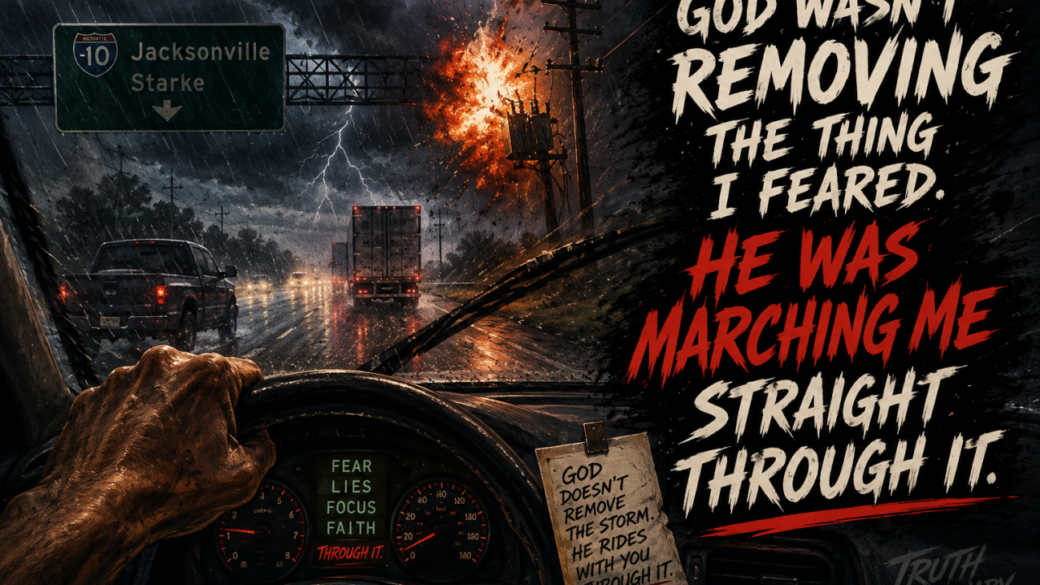
Yesterday at 4:30 p.m., I drove from Jacksonville to Starke on I-10 in what can only be described as God’s personalized interstate boot camp.
I have interstate anxiety.
Not the cute kind where someone says, “Highways make me nervous.”
I mean the kind where merging onto I-10 feels like being thrown into a Roman coliseum wearing flip-flops and armed with a pool noodle.
And Florida drivers are not helping.
They drive like every vehicle is either fleeing a bank robbery or racing to perform emergency open-heart surgery.
Then the rain started.
Not drizzle.
Not a shower.
Biblical nonsense.
The sky didn’t open.
It ruptured.
Rain came down so hard my windshield turned into a waterfall, like someone dumped the Atlantic Ocean through a funnel onto my hood.
My wipers were moving at full speed and accomplishing nothing—like trying to stop a house fire with a Super Soaker.
I could barely see.
The lane markers disappeared like truth at a political debate.
Fear has a funny way of turning ordinary things into predators.
Roads become traps.
Rain becomes an ambush.
A merge lane becomes a firing squad.
That’s what fear does.
It takes possibility and dresses it up as certainty.
Fear is a crooked lawyer arguing a rigged case inside your skull.
It presents exhibit after exhibit of disaster until your imagination becomes a horror film financed entirely by cortisol.
You’re not just driving.
No, according to fear, you’re seconds away from hydroplaning into a guardrail, pinballing across three lanes, and becoming tonight’s lead story.
Fear rarely screams.
It whispers.
And whispers are dangerous because they sound like your own voice.
Then came Highway 301.
And if the rain hadn’t already established dominance, the transformer finished the sermon.
I watched it explode into a fireball.
An actual fireball.
Orange flames.
Sparks.
Electrical chaos.
Boom.
It looked like heaven struck a match.
For one surreal second, it felt less like a commute and more like I’d driven onto the set of an apocalypse movie directed by a pyromaniac.
That’s when something clicked.
God was not removing the thing I feared.
He was marching me straight through it.
Not around it.
Not over it.
Through it.
We assume growth comes gift-wrapped in comfort.
Usually it arrives wearing combat boots.
I don’t particularly enjoy this truth.
I prefer the version where God gently removes obstacles like a divine concierge.
“Welcome, Amber. We noticed your anxiety, so we’ve upgraded you to clear skies and light traffic.”
That has not been my experience.
Sometimes God teaches like a blacksmith.
He doesn’t admire raw metal.
He puts it in fire.
Heat first.
Hammer second.
Shape last.
Steel is not forged in comfort.
Neither is courage.
Sometimes the storm isn’t interrupting your progress.
The storm is manufacturing it.
Nothing captures attention like danger.
Nothing.
Nobody pulls over to admire a mildly overcast sky.
But explosions?
Explosions arrest the nervous system.
Tension grabs attention by the collar.
It doesn’t politely knock.
It kicks the door in.
Your body knows this instinctively.
Danger narrows focus.
Noise disappears.
Distraction evaporates.
Only what matters survives.
And that’s exactly why most writing fails.
Most writing feels like lukewarm soup.
Technically edible.
Emotionally forgettable.
People do not pay attention because something is useful.
They pay attention because something feels consequential.
Attention follows tension the way blood follows a wound.
Writers confuse information with importance all the time.
They say, “But my content provides value.”
That’s nice.
So does a microwave instruction manual.
Value alone does not create urgency.
Tension does.
Tension is the hook under the skin.
It creates friction.
Curiosity.
Conflict.
Stakes.
An unanswered question.
Something unresolved.
Something costly.
Without tension, writing has no engine.
It just sits there idling in neutral, burning fuel and going nowhere.
And readers can feel that instantly.
Your writing isn’t competing with other newsletters.
It’s competing with outrage, memes, breaking news, dopamine loops, text messages, and social media algorithms engineered like slot machines.
You are not writing in a library.
You are trying to whisper in a casino.
If your message lacks tension, it gets swallowed whole.
That drive changed something in me.
Not because it felt good.
Not because I enjoyed white-knuckling the steering wheel like it owed me money.
But because I made it through.
And when I got home, something had shifted.
The fear had lost some of its teeth.
That’s what both storms and great writing do.
They strip away illusion.
Storms expose what you trust.
Writing exposes what your reader believes.
Both force confrontation.
Both demand clarity.
Both reveal what matters.
God used tension to get my attention.
Writers should too.
So next time you sit down to write, ask yourself:
Where’s the storm?
Where’s the friction?
Where’s the wound?
Where’s the transformer about to explode?
Because if everything feels safe, polished, and comfortable…
your writing may be clean—
but clean writing often dies sterile.
No blood.
No pulse.
No voltage.
And sometimes the most loving thing God does—
and the most effective thing a writer can do—
is disturb the comfortable just enough to wake the dead.