
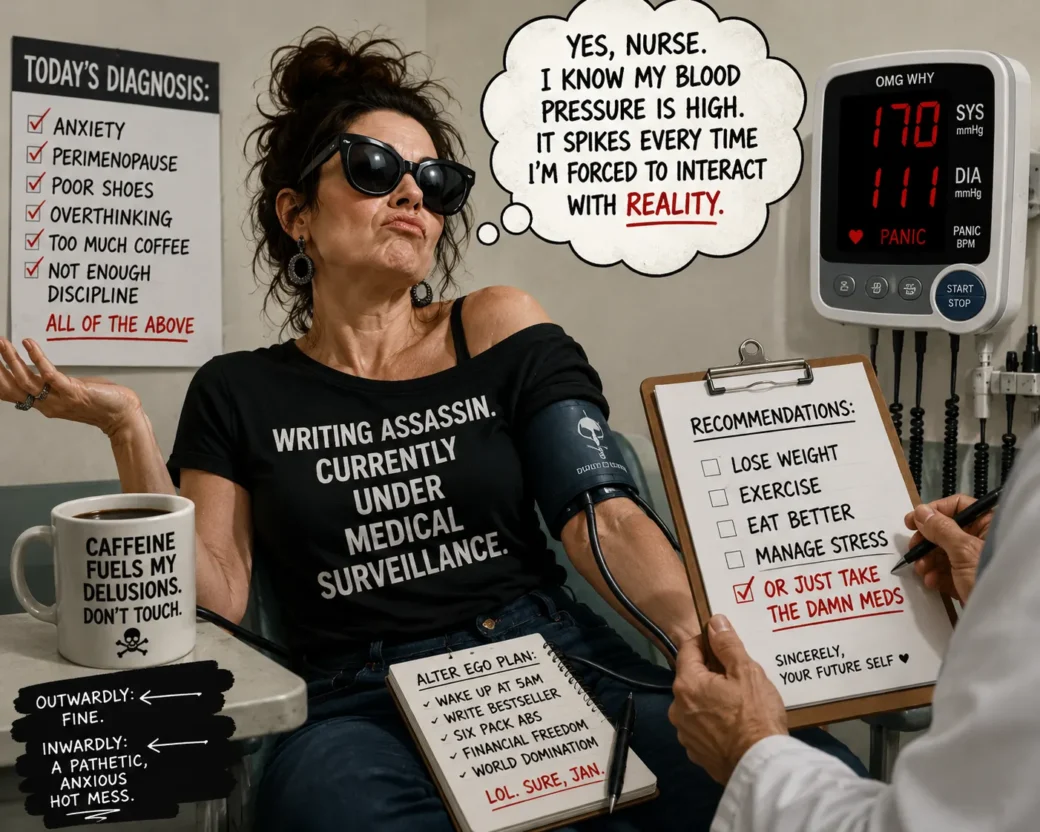
I always imagined my collapse looking cooler than this.
Not cinematic collapse.
Not whiskey bottles and neon lights and some dramatic “creative genius burns too bright” nonsense.
No.
Apparently my downfall arrived in the form of a middle-aged nurse wrapping a Velcro cuff around my arm while I silently tried not to poop from anxiety in a fluorescent room that smelled like disinfectant and stale despair.
“Your blood pressure is a little elevated.”
A little elevated.
Ma’am, the machine basically just played the soundtrack from Jaws.
170s over 111.
Every time they took it again, it got worse.
Because now we weren’t measuring blood pressure anymore.
We were measuring panic.
We were measuring humiliation.
We were measuring the emotional damage of being a formerly invincible twenty-something trapped inside the body of a perimenopausal goblin running on caffeine, cortisol, and delusion.
And the worst part?
The lecture.
God, the lecture.
You know the one.
The slow nodding.
The concerned face.
The careful medical voice people use when they’re trying not to say:
“So… have you considered maybe not stress-eating your emotions while marinating in existential dread?”
And here’s the insane part:
I already knew.
I knew I was overweight.
I knew I was stressed.
I knew my nervous system had the structural integrity of wet toilet paper.
I knew I had spent years living almost entirely inside my own head like a raccoon trapped in an abandoned arcade machine.
But knowing something and emotionally accepting something are two completely different universes.
Because my real problem was never blood pressure.
My real problem was that somewhere along the way, I accidentally fell in love with an imaginary version of myself.
And she ruined me.
The Alter Ego Problem
In my head, I am lethal.
In my head, I’m a writing assassin.
A mercenary.
Sharp. Disciplined. Dangerous.
The kind of woman who wakes up at 5 a.m., drinks black coffee, writes brilliant essays, has intimidating posture, and somehow owns seven notebooks that smell like cedar and conquest.
In my head, I’m the final evolved form.
But reality?
Reality is me Googling whether left eyebrow tension means imminent cardiac arrest while eating string cheese in pajama pants at 2 p.m.
Reality is me spiraling because my knee hurt for six months only to eventually discover the culprit was… shoes.
Shoes.
Not arthritis.
Not bone decay.
Not “your body is disintegrating due to age.”
Shoes.
I nearly built an entire emotional support identity around suffering before realizing I basically bought orthopedic terrorism from a discount rack.
That’s when I started realizing something horrifying:
My mind had become a catastrophe factory.
Every ache?
A prophecy.
Every symptom?
A potential documentary narrated by a British man with a calm voice describing my tragic decline.
And once your brain learns that game, it starts playing it constantly.
Tiny headache?
Excellent. Death.
Chest tightness?
Wonderful. Prepare the urn.
Muscle twitch?
Perfect. Surely the collapse of civilization begins now.
This is what anxiety does.
It turns your body into a haunted house attraction where every sensation jumps out screaming:
“BOO. YOU’RE DYING.”
Meanwhile your rational brain is in the corner holding a tiny flashlight whispering:
“It could literally just be dehydration…”
But anxiety doesn’t care about evidence.
Anxiety is a theater kid with cocaine energy.
White Coat Syndrome Is Psychological Waterboarding
People who don’t have white coat syndrome think it’s cute.
“Oh, you just get nervous at the doctor?”
No.
I become biologically possessed.
The moment I enter a medical building, my nervous system reacts like we’re storming Normandy.
My heart rate spikes.
My hands get cold.
My breathing changes.
I start mentally reviewing every unhealthy decision I’ve made since 1997.
And then comes the cuff.
The cuff is not a medical device.
The cuff is an interrogation tactic.
Because once that thing tightens around your arm, suddenly you become aware of your own mortality, sodium intake, unresolved childhood wounds, and every drive-thru order you’ve ever placed after 10 p.m.
Then they stare at the numbers.
And if the numbers are high?
They do the worst thing imaginable.
They take it again.
Fantastic.
Now I’m anxious about being anxious.
The second reading is always worse because now my brain is screaming:
“CONGRATULATIONS. YOU ARE FAILING BLOOD PRESSURE.”
By the third reading, I’m essentially a hostage situation with earrings.
And what nobody talks about is how the anxiety doesn’t end after the appointment.
No.
It follows you home.
It sits next to you on the couch.
It rides shotgun in the car.
It wakes up beside you at 3 a.m. and whispers:
“What if this time it’s real?”
That was the true exhaustion.
Not the blood pressure itself.
The rumination.
The hypervigilance.
The constant internal surveillance.
I wasn’t living inside my body anymore.
I was monitoring it.
Then Came the Medication
Losartan.
25 milligrams.
Which, according to my brain, was basically the ceremonial beginning of old age.
I took that first pill like a Victorian woman accepting a terminal diagnosis.
I expected thunder.
Trumpets.
Maybe a crow landing dramatically outside my window.
Instead?
Something deeply annoying happened.
I got calmer.
Like…
noticeably calmer.
Not euphoric.
Not sedated.
Just… less hunted.
And honestly?
That pissed me off.
Because I didn’t want the medication to help.
I wanted to heroically resist it.
I wanted to conquer everything naturally through discipline, mindset, kale smoothies, and the spiritual power of denial.
Instead, within hours, my nervous system unclenched like a fist opening after twenty years.
Suddenly the doom spiral quieted down.
And that created a terrifying realization:
What if I hadn’t been fighting weakness?
What if I’d been fighting support?
See, people attach morality to medication.
Especially people obsessed with self-improvement.
We think taking medication means we failed.
That we lacked discipline.
That we should’ve “handled it ourselves.”
As if the human body is a customer service complaint you can resolve through positive thinking and protein intake.
But here’s the uncomfortable truth nobody wants to admit:
Some people are so used to suffering that relief feels suspicious.
And I was one of them.
The Fantasy Self Is Killing People
This is bigger than blood pressure.
This is about the fantasy self.
The imaginary version of ourselves we keep holding hostage over our real lives.
You know the fantasy self.
The future you who finally gets it together.
The fit you.
The disciplined you.
The successful you.
The emotionally regulated you.
The millionaire you.
The deeply moisturized you.
That person becomes emotionally dangerous because we start treating our current self like a failed prototype instead of a human being.
And every year that passes without becoming that fantasy version creates another layer of shame.
That’s what hit me hardest about needing blood pressure medication.
Not the medication itself.
The symbolism.
Because somewhere in my subconscious, I believed:
Powerful women don’t need blood pressure medication.
Powerful women have six-packs and morning routines and inspirational lighting.
Powerful women don’t cry in parking lots after doctor appointments while stress-eating almonds like a frightened squirrel.
But reality eventually kicks down the door.
And at 50, reality doesn’t knock politely anymore.
Reality arrives with invoices.
Midlife Is Brutal Because It Removes Your Alibis
When you’re younger, you can still pretend.
You can tell yourself:
“I’ll get serious later.”
“I’ll lose the weight eventually.”
“I’ll become disciplined next year.”
“I’m still figuring things out.”
But midlife changes the emotional math.
Because eventually you realize:
Oh.
This isn’t rehearsal anymore.
This is the actual life.
And that realization hits like a folding chair to the soul.
Especially when your inner identity never updated.
That’s the bizarre thing about aging.
Inside, you still feel psychologically young.
You still feel like yourself.
Then one day your knees sound like microwave popcorn when you stand up and suddenly your body sends an email saying:
“Good afternoon. We need to discuss infrastructure concerns.”
Nobody prepares you for the grief of realizing time passed while you were busy surviving.
And maybe that’s why so many people panic in midlife.
Because they suddenly become aware of the gap.
The gap between:
who they imagined becoming
and
who they actually became.
That gap can destroy people.
Especially ambitious people.
Especially creative people.
Especially people who built entire emotional identities around potential instead of embodiment.
Here’s the Part Nobody Expects
The blood pressure medication didn’t make me feel weak.
The spiral did.
The constant fear did.
The obsession did.
The hyperfixation did.
The endless self-surveillance did.
That was the thing draining my life force.
Not the pill.
And once I realized that, something shifted.
Not magically.
Not overnight.
But enough.
Enough to see that maybe the goal isn’t becoming my alter ego.
Maybe the goal is becoming integrated.
Because my alter ego was never actually a human being.
She was armor.
She was a psychological witness protection program designed to protect me from disappointment.
If I could just become “powerful enough,” maybe I’d finally feel safe.
Worthy.
In control.
But control is a scam.
Your body will humble you eventually.
Time will humble you eventually.
Reality will humble you eventually.
The question is whether humility destroys you…
or frees you.
The Race to Lose Weight
Now listen.
The moment someone gets put on blood pressure medication, something primal activates.
Suddenly you’re standing in your kitchen at midnight bargaining with spinach.
“I can fix this.”
Every commercial becomes personal.
Every staircase becomes symbolic.
Every carbohydrate feels like organized crime.
And yes, I immediately went into:
“I WILL LOSE 50 POUNDS IN THREE MONTHS.”
Which is emotionally understandable and biologically unhinged.
Because fear creates urgency.
And urgency feels productive.
But panic is not transformation.
Panic is just adrenaline wearing a motivational speaker costume.
Still, there was something valuable hiding underneath that urgency.
Awareness.
For the first time in years, I wasn’t fantasizing about becoming someone else.
I was finally confronting the life I actually had.
The body I actually had.
The habits I actually had.
The nervous system I actually had.
And weirdly?
That confrontation felt more honest than all the years I spent living inside motivational hallucinations.
The Most Dangerous Thing in the World
The most dangerous thing in the world is not failure.
It’s dissociation from reality.
It’s living entirely in imagined futures while neglecting the life currently happening to you.
That’s how years disappear.
That’s how health disappears.
That’s how people wake up one day staring at a prescription bottle wondering how the hell they got here.
Not because they’re lazy.
Not because they’re stupid.
But because avoidance is seductive.
Fantasy is seductive.
The imagined self always feels cleaner than the lived self.
But eventually your body demands participation.
Mine certainly did.
And honestly?
Good.
Because maybe this entire humiliating, anxiety-soaked, blood-pressure-cuff nightmare was necessary.
Maybe I needed something loud enough to interrupt the fantasy.
Maybe I needed a moment that forced me to stop treating myself like a future project and start treating myself like a current human being.
Not optimized.
Not transformed.
Not legendary.
Just alive.
And Maybe That’s the Real Power
Not domination.
Not perfection.
Not becoming some impossible cinematic version of myself.
But learning how to stop abandoning myself every time reality disappoints me.
Because the truth is:
I am not my alter ego.
I am the woman who panics at doctor appointments.
The woman who spirals.
The woman who catastrophizes.
The woman who bought demonic shoes.
The woman who still wants a powerful life while dragging around fear like an emotional support raccoon.
And maybe power isn’t becoming someone untouched by fear.
Maybe power is finally seeing yourself clearly…
without flinching.
Even at 170 over 111.
Especially then.