
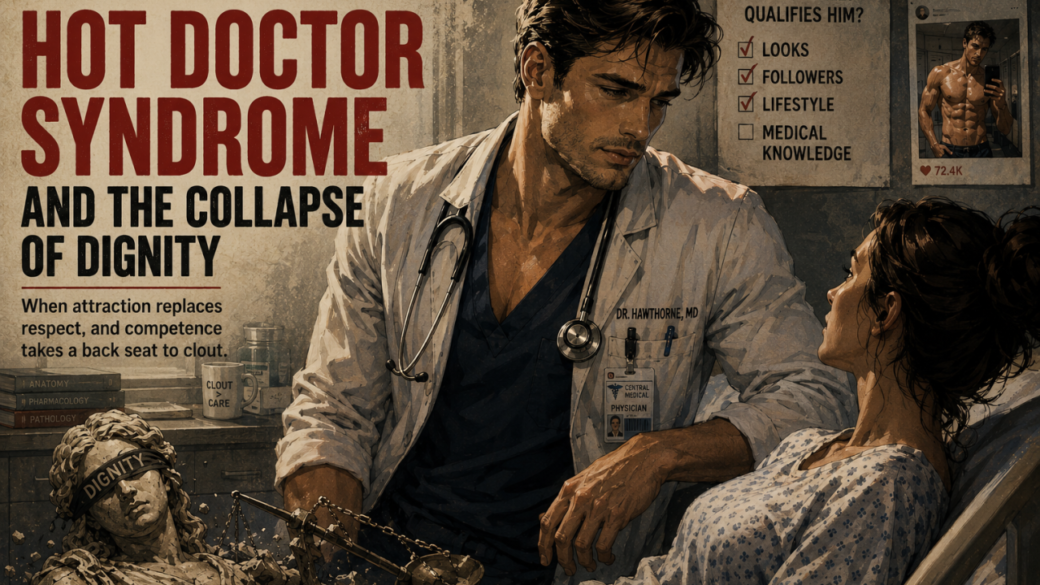
Ever find yourself in the ER in the middle of the night?
It was during a couple of ER visits years ago that I learned a universal truth—The SECOND you find yourself balancing on one foot, one hand leaning against a hospital bed, the other hand trying to wiggle your jeans onto the floor as fast as you can so you can put on a hospital gown before another stranger walks in on you while your jiggly bits dangle as you’re trying to hold onto what little dignity you have left--You can rest assured you’ll come down with a sudden case of H.D.S-- Hot Doctor Syndrome.
They’ll always show up when you least expect it. And even wearing a mask you can still tell they’re hot. The short haircut. The tight, athletic build. Their confident, professional nature as they discuss your nether regions. And as you’re trying to hold it together, not show any emotion but inside your brain is beating against your skull screaming “Take me now!” you ask yourself... “how can I turn this into a book idea?”
Or is it just me?
A couple bags of blood and iron infusions later to treat severe anemia and a blood clot in the leg, I eventually felt like myself again—which I’m happy to report included a firm decision from both me and my jiggly parts to stay far away from the ER and any Dr. Hotties who try to unnerve me. After all, I’ve got books to write. Worlds to build. And experiences to create for you.
But here’s what nobody tells you about the ER.
It’s not just a place where your body gets examined.
It’s a place where your dignity gets deconstructed.
Piece by piece.
Without permission.
We talk about hospitals like they’re sterile environments.
Clean. Controlled. Clinical.
That’s a lie we tell ourselves so we can sleep at night.
Because the truth is, the moment you step into that system, you are no longer a fully composed human being. You are a series of access points. Blood pressure. Oxygen levels. Symptoms. History. Pain scale from one to ten.
Nobody asks what your dignity level is.
Nobody charts that.
And yet it drops faster than your jeans around your ankles when you’re trying to step into a paper gown that was clearly designed by someone who has never met a real human body in motion.
This is the quiet tension nobody names out loud:
We expect dignity to survive exposure.
But exposure is the opposite environment dignity was designed for.
In the ER, you don’t just lose privacy—you lose choreography.
The careful ways you manage how the world sees you stop working. There is no posture that makes you look composed while a nurse is wrapping a blood pressure cuff around your arm and asking if you’ve had any recent trauma like you’re supposed to casually list your life falling apart between breaths.
And then there’s the weirdest contradiction of all.
The people seeing you at your most exposed are often the calmest people in the room.
Doctors. Nurses. Techs.
They move through your vulnerability like it’s just another Tuesday.
Which is exactly what makes it more disorienting.
Because you are internally screaming, “Do not perceive me like this,” while they are professionally documenting every inch of what you wish could remain unseen.
That’s where dignity starts to fracture.
Not from pain.
From being seen without ceremony.
We build our lives around controlled visibility. We choose when we’re polished. When we’re tired. When we’re presentable. When we’re “ready for company.”
The ER takes that system and deletes it.
Hard reset.
And suddenly you realize how much of your identity depends on being able to curate your presentation.
Because without that control, something strange happens.
You don’t just feel exposed.
You feel translated.
Like you’ve been converted from a person into a problem to be solved.
And here’s where it gets even more uncomfortable.
Because part of you wants to still be “seen well.”
Even when everything is falling apart.
Even when your body is betraying you.
Even when you are literally holding up a gown that doesn’t close in the back while trying to maintain eye contact like this is fine, everything is fine.
That instinct—that need to preserve dignity inside exposure—that’s the human contradiction.
We don’t stop caring how we’re perceived just because we are unwell.
We care more.
Which is absurd.
And very, very human.
But there’s another layer.
Because exposure doesn’t just strip dignity—it tests it.
It asks a brutal question:
Who are you when you can’t manage how you’re seen?
Not when you’re polished.
Not when you’re performing competence.
Not when you’ve had time to assemble your face and your posture and your narrative.
But when you are fully unassembled.
Lying under fluorescent lights.
Being asked to scoot “just a little more” while already feeling like you’ve been reduced to coordinates on a hospital chart.
That’s the edge.
Not the medical situation.
The identity situation.
And maybe that’s why I can still laugh about Hot Doctor Syndrome.
Because humor is what shows up when dignity can’t fully hold the line.
It sneaks in through the cracks of exposure and says, “Yes, this is humiliating… but also, what a ridiculous experience to be alive inside.”
The truth is, I didn’t leave those ER visits just healthier.
I left more aware.
Not of my body.
But of how fragile the structure of “composure” really is.
We think dignity is something we carry.
Something internal.
But it turns out dignity is often just the agreement between you and the world that you won’t be observed too closely at the wrong moment.
The ER breaks that agreement.
And when it does, you find out what’s underneath.
Not always strength.
Not always grace.
Sometimes just the raw, awkward, very human desire to still be seen as whole—even when you are very clearly in pieces.
And maybe that’s the real tension.
Not exposure itself.
But the stubborn refusal of the self to stop reaching for dignity even when the conditions make it impossible.
Which brings me back to that hospital room.
Balancing. Adjusting. Trying to stay composed.
Because even when everything is exposed…
something inside still insists:
“I am more than what you are seeing right now.”