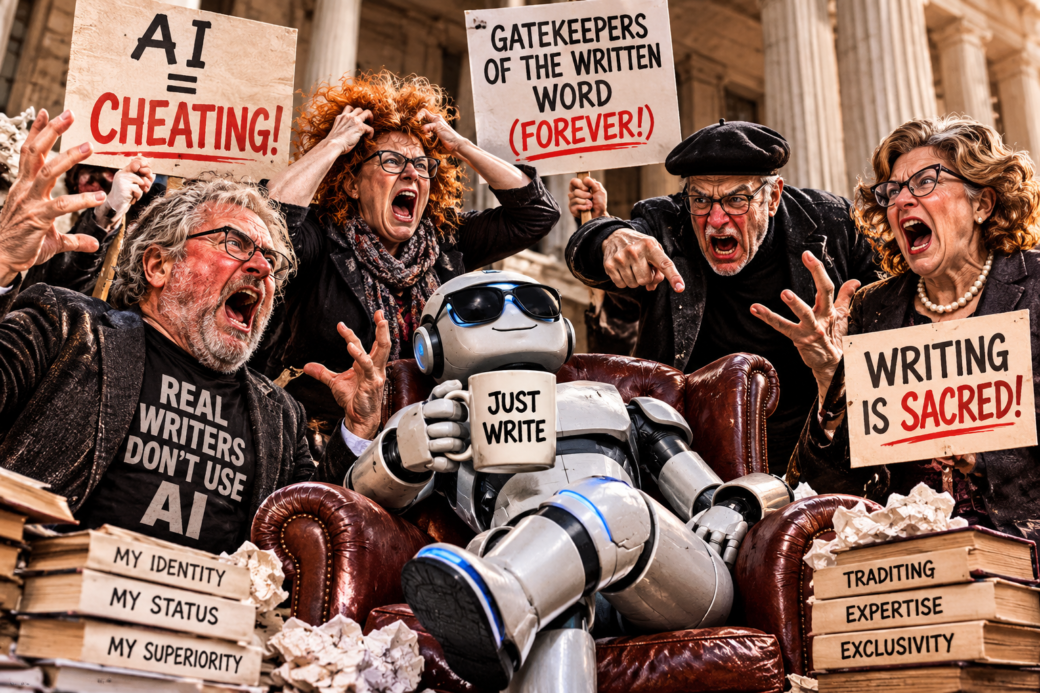
Some people aren't afraid AI will replace their writing. They're afraid it will replace the part of their identity that made them feel special.
There's a difference.
And if you've spent the last several months calling everyone who uses AI a lazy, talentless fraud, I have a question. Are you defending the integrity of writing, or are you defending your position in the writing hierarchy?
Because those aren't necessarily the same thing.
I have a theory about some of the more spectacular meltdowns happening in the writing community. I don't think the real problem is always what AI produces. I think the problem is what its existence represents to people who have spent a significant portion of their lives building an identity around being a writer.
And that, my friends, is a much more interesting problem than whether ChatGPT knows how to use a semicolon.
When Your Identity Becomes Your Resume
Imagine spending 25 years establishing yourself as the person who knows how to write.
You've studied grammar. You've mastered sentence structure. You've spent thousands of hours wrestling with paragraphs that refuse to cooperate. You've developed a vocabulary that makes other people reach for a dictionary and question their educational decisions.
You've earned your place at the table.
Then along comes a tool that can produce a reasonably coherent article in seconds.
Suddenly, the thing you've spent decades using to distinguish yourself isn't quite as exclusive as it used to be.
Your skills haven't disappeared. Your knowledge hasn't evaporated. Your fingers still work. But the neighborhood isn't nearly as impressed with your 90 words per minute anymore because everybody has a computer.
And I suspect that's an uncomfortable adjustment for some people.
See, there's a difference between being good at something and needing to be recognized as someone who is good at something. The first is a skill. The second is an identity investment.
When you've spent years establishing your status around a particular ability, watching other people gain access to that ability through a different process can feel like somebody just rearranged the furniture in your house without asking.
Except nobody touched your furniture. They just bought their own damn couch.
The Literary Country Club Is Having a Problem
There's something fascinating about the way some people approach the idea of being a writer.
Evidently, there's an invisible membership committee somewhere that determines who qualifies. You must suffer appropriately. You must follow the approved process. You must demonstrate sufficient dedication to the sacred art of staring at a blinking cursor until your eyeballs begin to dry out.
And heaven forbid you invite a technological assistant into the creative process.
Suddenly, you're an impostor. A fraud. A talentless hack who has never experienced the spiritual journey of spending six hours trying to make one paragraph sound less like it was written by a tax accountant.
Some people seem genuinely offended that others can produce respectable work without following the same traditional path they followed.
But here's a question worth considering: Is writing about producing meaningful work, or is it about protecting the status of people who have historically been good at producing it?
Because if your value depends on being the only person who can do something, innovation is going to feel like a personal attack.
And you are going to have a very long, miserable life.
The Moral Superiority Olympics
Have you noticed how quickly some AI conversations move away from the actual writing and toward the character of the person using the tool?
Instead of asking whether the work is original, compelling, accurate, useful, or interesting, suddenly we're discussing whether the person who produced it is lazy, dishonest, unintelligent, or morally bankrupt. Using an AI assistant now requires a character reference from three respectable members of the literary community and a notarized statement from your high school English teacher.
That's a convenient little maneuver.
If you can establish that the other person is morally defective, you never have to examine whether their work is any good. You don't have to compete with their results. You don't have to acknowledge that they might have a different creative process that works perfectly well for them.
You simply get to sit on your imaginary throne and issue judgments.
Now, before somebody starts hyperventilating into their copy of The Elements of Style, let's establish something. There are legitimate concerns surrounding AI. Plagiarism, copyright, fabricated information, transparency, and the mountains of generic garbage being dumped onto the internet are all reasonable subjects for discussion.
AI can produce terrible writing. So can humans. I've seen oatmeal with more personality than some professionally published content.
But criticizing bad writing is different from declaring everyone who uses a particular tool intellectually inferior. If the work is bad, criticize the work. If it's plagiarized, address the plagiarism. If it's inaccurate, point out the inaccuracies.
Calling somebody a fraud doesn't magically make their writing bad.
Anyway, Speaking of People Who Need to Mind Their Own Business...
Have you ever noticed that there's always somebody in a neighborhood who gets personally offended by another person's Christmas decorations?
I'm not talking about anything dangerous. I'm talking about a perfectly harmless inflatable Santa Claus sitting in someone's front yard.
There'll be one house with a 14-foot inflatable snowman, three reindeer, a light-up nativity scene, and enough extension cords to power a small manufacturing facility.
And somebody three houses down is absolutely furious.
Not because the snowman is hurting anybody. Not because the reindeer are blocking traffic. But because apparently there's a certain standard of acceptable Christmas decorating, and this person has appointed themselves the Supreme Court of Inflatable Holiday Entertainment.
They'll complain. They'll make comments. They'll discuss property values. They'll probably start a Facebook thread titled "A Concerned Resident Has a Question."
Meanwhile, the family with the inflatable snowman is sitting inside drinking hot chocolate, completely unaware that they've triggered a municipal-level constitutional crisis.
I always wonder what it must be like to go through life with so much emotional energy invested in what somebody else puts in their front yard.
Imagine having that much free time. I can't even remember to take the trash cans back up the driveway.
Anyway...
Back to the writers.
You don't have to like somebody else's Christmas decorations. You don't even have to understand why anyone would want a 14-foot inflatable snowman. But at some point, you have to recognize that their front yard isn't your jurisdiction.
And neither is somebody else's writing process.
The Tantrum Is Not the Argument
There's something particularly entertaining about watching adults respond to technological developments by throwing emotional furniture around.
The insults. The declarations. The dramatic announcements that anyone using AI isn't a real writer. The endless proclamations that creativity is dead because somebody asked a chatbot to help organize their thoughts.
Imagine announcing that anyone who uses a calculator isn't a real mathematician. Anyone who uses a dishwasher isn't a real adult. Anyone who uses GPS isn't a legitimate traveler.
At some point, the argument stops being about the tool and starts looking suspiciously like a toddler having a tantrum because somebody changed the rules of their favorite game.
And here's what I find especially interesting: some of the loudest voices seem far more interested in policing who gets to call themselves a writer than in discussing what actually makes writing worth reading.
You can defend the craft without appointing yourself the sheriff of everybody else's creative process.
You don't own the word writer. You don't own the process. And you certainly don't own everybody else's creative decisions.
Maybe You Should Be Asking a Different Question
Here's what I think gets lost in all this noise.
Writing isn't valuable because it's difficult. It's valuable because of what someone can communicate through it.
The ideas. The perspective. The observations. The imagination. The ability to recognize something happening in the world and connect it to a thought that makes another human being stop scrolling for five seconds.
Those things still matter.
AI hasn't eliminated the need for original thinking. It hasn't eliminated the need for judgment, curiosity, experience, or a point of view. It hasn't magically given everyone something interesting to say.
It has changed the process through which people can develop and communicate their ideas.
And maybe that's the part some people are having difficulty accepting.
If you've spent decades mastering the mechanics of writing, that's wonderful. Those skills are valuable. But what happens when you stop treating those skills as the entirety of your identity?
What happens when you recognize that being a writer is about more than how you get the words onto the page?
A person with something meaningful to say doesn't suddenly become less interesting because they use assistance getting it said.
And a person with nothing meaningful to say doesn't become a brilliant writer simply because they refuse to use AI.
If your writing is valuable, a tool doesn't make it less valuable. And if your writing isn't valuable, blaming somebody else's tools isn't going to fix it.
Maybe AI isn't threatening your ability to write.
Maybe it's threatening the idea that your ability to write makes you special.
And if that's the case, perhaps it's time to find something a little bigger to build your identity around.
Because the writing world doesn't need another self-appointed literary gatekeeper guarding the entrance with a red pen and a superiority complex.
It needs people with something worth saying.
Preferably without a permission slip from the inflatable snowman committee.
P.S. If you're tired of watching people clutch their pearls every time someone mentions AI, and you'd rather learn how to use the tool without handing over your brain, your voice, or your creative authority, I have something for you.
It's called The AI Outlaw.
It's a self-paced workshop designed to help writers use AI as an assistant—not a ghostwriter. You'll learn how to bring your own ideas, observations, personality, and perspective to the table, then use AI to help you turn those ingredients into stronger writing.
No robotic word vomit. No surrendering your voice. No waiting for the Writing Police to issue you a permit.
WRITE YOUR RULES. OWN YOUR WORDS.
Become an AI Outlaw — Get the Workshop Here