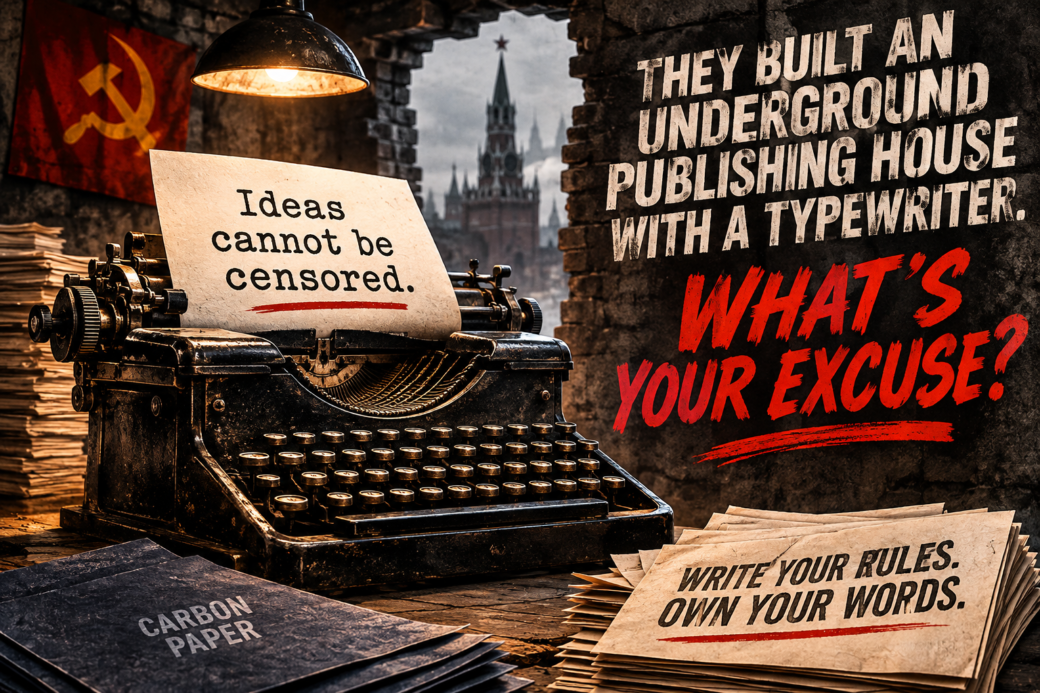
Somewhere in the Soviet Union during the middle of the twentieth century, a writer sat hunched over a typewriter. No publishing contract. No literary agent. No editor waiting to approve the manuscript. No bookstore distribution deal. Just a typewriter, a stack of thin paper, sheets of carbon paper, and something the authorities didn't particularly want people reading. It wasn't exactly the glamorous publishing career most writers dream about. Nobody was offering a book advance or inviting this person onto a podcast. But there was a message that needed to get out, and apparently nobody had bothered to explain to this writer that publishing required permission.
The writer typed. And typed. And typed. Using carbon paper, multiple copies of the same document could be produced in one sitting. Those copies were passed from person to person, reproduced, and circulated through an underground network of readers, writers, and distributors. They called it samizdat, a Russian term meaning self-publishing. It became an underground publishing system for literature and ideas that Soviet authorities suppressed. Think of it as a publishing house without the publishing house, a distribution network without the distribution department, and a literary establishment without anybody sitting behind a desk deciding whose ideas deserved oxygen.
Some writers are still waiting for permission to publish. Others have built their own damn printing press.
And before somebody gets their ideological knickers in a twist, no, I'm not suggesting that a Facebook argument about artificial intelligence is equivalent to Soviet censorship, government repression, or the dangers faced by actual dissidents. Those were very different circumstances with very real consequences. But there's a principle worth examining here. When the established system doesn't give you the tools, access, or approval you want, you have a choice. You can stand outside the gate and complain, or you can find another way to get your message into the world.
THE GATEKEEPERS HAVE ENTERED THE CHAT
I've noticed something fascinating about the way people respond to new technology. The moment something unfamiliar arrives, an entire population suddenly develops an impressive collection of opinions about why nobody should use it. AI shows up, writers start experimenting, and suddenly the literary police are conducting roadside sobriety tests on everybody's creative process. Are you using AI? How much? Did you write every sentence with your own two hands? Did a robot suggest that adjective? Please step away from the keyboard. We have questions.
We've had bad writing since long before AI showed up. We've had emails that say absolutely nothing in 400 words. We've had motivational posts that sound like a fortune cookie got a business degree. We've had websites assembled from sentences that appear to have been selected by throwing darts at a thesaurus. We've had entire books published with the intellectual depth of a damp paper towel. But sure, let's blame the newest tool in the room. Apparently, mediocre writing was a perfectly respectable profession until artificial intelligence came along and ruined everything.
Now, let's be fair. AI absolutely can produce generic, lifeless, repetitive content. It can generate inaccurate information. People can use it to avoid thinking, manufacture content, and pass off work they haven't meaningfully contributed to as their own. Those are legitimate concerns. I have no interest in defending intellectual laziness just because somebody happens to be using a shiny new piece of technology. But here's where the argument falls apart: a tool capable of producing mediocre work is also capable of helping a thoughtful writer examine an idea, challenge an argument, explore a metaphor, or improve a piece of writing. The existence of bad output doesn't prove the tool is useless. It proves bad output exists.
And there's something else going on here. Some writers seem more interested in protecting the traditional definition of what it means to be a writer than they are in exploring what writers might be capable of becoming. When protecting the label becomes more important than developing the skill, curiosity is usually the first casualty. That's a dangerous trade for anyone whose entire profession depends on thinking, communicating, and creating.
Creative freedom that comes with a list of approved tools isn't creative freedom. It's a permission slip.
THE TYPEWRITER DIDN'T GET A BYLINE
Here's something worth remembering about those Soviet underground publishers. The typewriter didn't write the message. The carbon paper didn't develop the argument. The paper didn't decide which ideas were worth circulating. The human being behind the machine did. The writer brought the observations, the experiences, the convictions, the questions, and the ideas. The machine helped reproduce the words. Nobody was handing the typewriter a book contract or asking it to autograph copies.
We seem to have developed a peculiar habit of confusing the instrument with the person using it. Give two people the same hammer. One builds a beautiful piece of furniture. The other puts a hole in his neighbor's wall. Give two writers access to AI. One uses it to manufacture generic content without contributing an original thought. Another uses it to explore an idea they've been wrestling with for three days, identify a weakness in their argument, and find a more compelling way to communicate something they genuinely believe. Are we really going to pretend those are the same creative process?
Consider how many tools writers have adopted throughout history. Typewriters replaced handwriting for many professional applications. Word processors changed editing and revision. Spellcheck changed proofreading. Search engines changed research. Email changed distribution. Self-publishing changed access to the marketplace. Each new development gave writers another way to work. Each one also gave somebody a reason to complain that the old days were better. At this rate, we'll eventually have people arguing that writers should return to chiseling their manuscripts into stone because at least the chisel never suggested a different word.
The important distinction isn't whether a tool participated in the process. It's whether the writer contributed the thinking, exercised judgment, maintained control, and took responsibility for the finished work. Using a tool doesn't mean surrendering authorship. Surrendering your thinking does. And if you can't tell the difference, you might want to spend less time policing other people's keyboards and more time examining your own creative process.
STOP CONFUSING THE TOOL WITH THE PERSON HOLDING IT
I don't use AI because I have nothing to say. Quite the opposite. I have observations, opinions, experiences, arguments, ideas, and more than enough sarcastic commentary to keep a small publishing operation busy for several lifetimes. I use AI because I want to explore what I can do with those ideas. I might bring it an observation and ask it to help me explore the underlying truth. I might challenge it to find holes in an argument or suggest a metaphor I haven't considered. I might use it to organize a collection of thoughts that are currently behaving like a dozen caffeinated squirrels in a cardboard box.
But the ideas are mine. The opinions are mine. The experiences are mine. I decide what makes sense, what doesn't, what needs more work, and what deserves to be published. AI doesn't get to decide what I believe, what I stand for, or what goes under my name. That's my job. The technology can assist with the process, but it doesn't get to assume command of the mission.
Somewhere along the way, we've confused using assistance with being incapable. By that logic, professional photographers should be embarrassed about using editing software, musicians should apologize for using recording equipment, and architects should probably throw their computer-aided design programs into the nearest dumpster. After all, if you really know what you're doing, shouldn't you be able to accomplish everything without assistance? Perhaps we should also eliminate electricity. I hear it's making people terribly dependent on light bulbs.
Here's the universal truth: You cannot judge a tool by the worst work somebody produces with it. You judge the work by its quality, its integrity, its originality, and the standards of the person responsible for producing it. And you judge the writer by the thinking behind the words, not by whether they used a particular tool to help get those words onto the page.
THE NEW UNDERGROUND PUBLISHERS
The people behind samizdat didn't have a fancy publishing house. They didn't have a marketing department, a distribution agreement, or a social media strategy. They had a way to reproduce their words and a network of people willing to circulate them. One reader could become the next distributor. One copy could become several. The technology was ordinary. The determination to communicate wasn't.
Think about what today's writers have access to. You can research, organize, develop, challenge, edit, and distribute your work without waiting for a traditional publishing institution to open its doors. You can build your own publishing operation. You can create your own workflow. You can establish your own standards and decide which tools belong in your creative arsenal. You don't need a literary establishment to certify that you're allowed to have an original thought, and you certainly don't need a committee of strangers on Facebook to approve your writing process.
But there's a catch. You have to be willing to take responsibility for your decisions. You have to learn the tools, understand their limitations, verify information, protect your intellectual integrity, and exercise your own judgment. You can't hand a machine the keys to your creative kingdom and then act surprised when it drives your message into a ditch. The goal isn't to eliminate your responsibility. It's to expand your capabilities without surrendering control.
And if your entire creative process depends on whether the loudest person in a Facebook group approves of your tools, you haven't built creative independence. You've simply traded one gatekeeper for another. This time, the gatekeeper doesn't even have a publishing contract to offer you. Just a strongly worded comment and a profile picture of a cat.
YOU ARE THE WRITER. ACT LIKE IT.
I didn't create The AI Outlaw to teach people how to hand their brains over to a machine. I created it because I believe writers can use powerful tools without surrendering their ideas, their voices, or their intellectual ownership. I believe the person with the original observation, the interesting perspective, the lived experience, and the willingness to think critically should remain in command of the creative process. AI should be your assistant, not your ghostwriter. Your thinking should drive the process. Your judgment should control the output. Your standards should determine what gets published.
You don't have to use AI. You don't have to embrace every new technology. But you should understand what something can do before deciding what it cannot do. You should be willing to experiment before announcing that an entire category of tools is incompatible with creativity. And you should be capable of distinguishing between a legitimate concern about intellectual integrity and somebody else's personal discomfort with change. Those are not the same thing, no matter how dramatically somebody types their opinion in all caps.
The samizdat writers didn't worship their typewriters. They used them. They understood that the machine was a means of getting the message into the world. The technology served the mission. The human being remained responsible for the words. That's the distinction I want more writers to understand. You can respect your craft without worshipping the limitations of the past. You can embrace new capabilities without abandoning your standards. You can use a tool without becoming a tool.
The machine was never the point. The message was.
So don't become a machine's ghostwriter. And don't become a gatekeeper's obedient little typist, either. Become the writer in command. Learn the tools. Own your ideas. Protect your integrity. Develop your voice. And when somebody tells you there's only one approved way to create, remember the people who built an underground publishing house with a typewriter and a stack of carbon paper.
Some writers are still standing outside the gate, waiting for permission.
Others are already printing.
WRITE YOUR RULES. OWN YOUR WORDS.
—Amber
P.S. Those Soviet writers didn't wait for the publishing establishment to hand them permission slips. They found a way to get their words into the world. And you can, too.
You don't have to surrender your creativity to AI. You don't have to let AI write your work. And you sure as hell don't have to sit on the sidelines because somebody decided that using a new tool makes you a lesser writer.
You need to know how to put the technology to work WITHOUT handing over the keys to your creative kingdom.
That's exactly why I created The AI Outlaw.
It's a self-paced writing workshop that shows you how to use AI as your creative assistant, not your ghostwriter. You'll learn how to take YOUR original observations, ideas, opinions, and experiences and turn them into compelling content while keeping your voice, your judgment, and your integrity firmly in command.
No generic AI slop. No surrendering your brain. No asking the writing police for permission.
Just you, your ideas, and a powerful new tool in your arsenal.
Ready to stop asking permission and start writing by your own rules?
BECOME AN AI OUTLAW — GET THE WORKSHOP HERE.
WRITE YOUR RULES. OWN YOUR WORDS.