
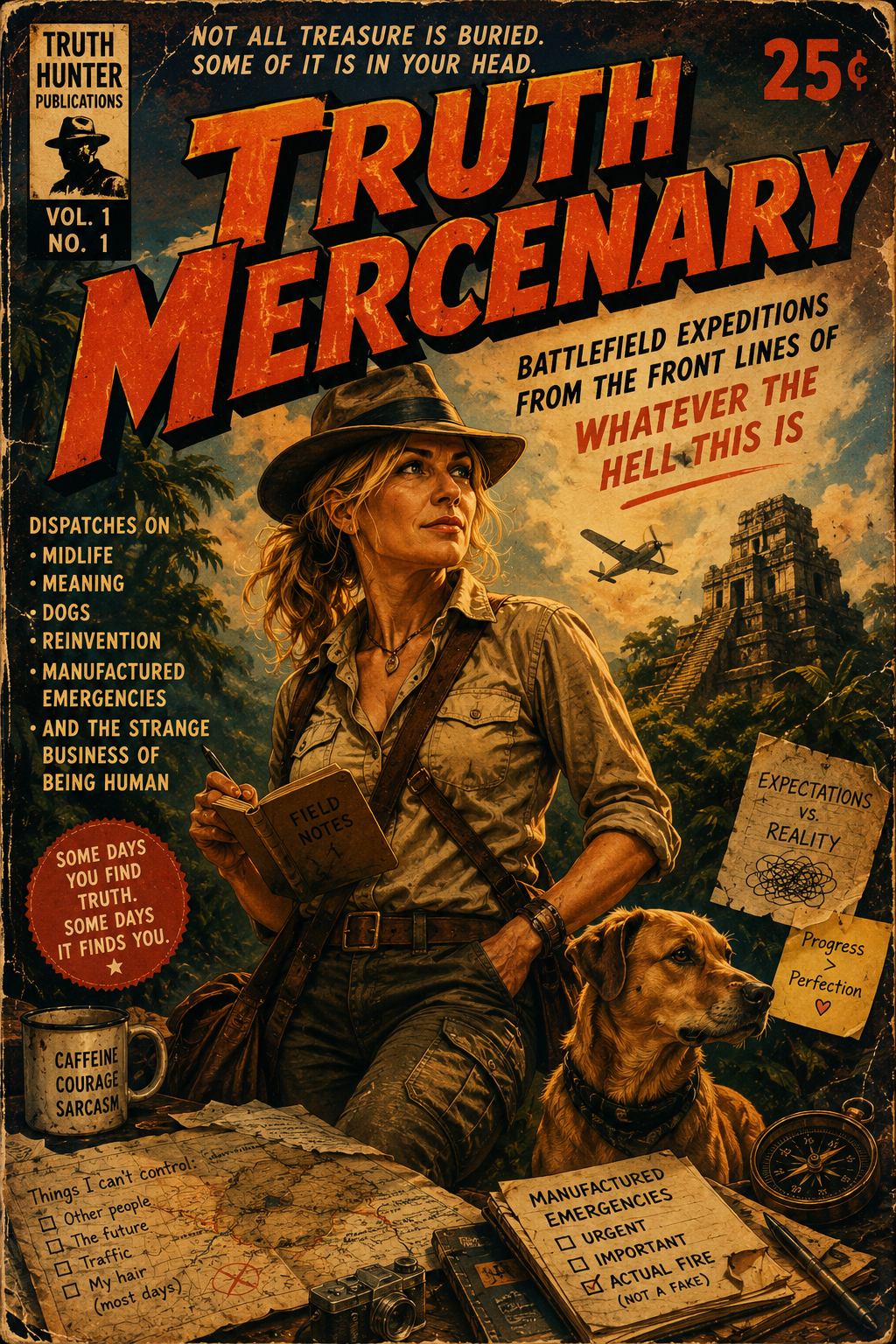
This week, I decided I was going to get my life together.
Not in the dramatic, buy-a-new-planner-and-become-a-completely-different-person-by-Monday kind of way. I was being reasonable about it. Mature, even. The sort of woman who has finally learned from her mistakes and is ready to approach life with a sensible, strategic mindset.
I took all those household projects that have been hanging over my head for years, broke them into manageable little tasks, and stuck Post-it notes beside each day in my planner.
One or two tasks a day. Nothing outrageous. Nothing that should require a search-and-rescue team.
I was optimistic. This was going to work.
It's been three days.
The Post-it notes are still there.
Apparently, my planner and I have different ideas about who's running this household.
But something about those little yellow squares has been bothering me. And I don't think the problem is that I need a better planner, a more elaborate productivity system, or a motivational speech delivered by a Navy SEAL.
I think the problem might be much more interesting than that.
What If Getting My Life Together Is the Problem?
I've been wondering whether my brain sees the very changes I want to make as some kind of danger.
Think about it.
If I actually follow through on these projects, my house will start looking different. The things I've let go of for years will finally get done. I'll become someone who lives in a cleaner, more organized environment because that's simply how I live now.
Not because I had a burst of motivation on a Tuesday. Not because I made a particularly inspiring list. Because those standards have become normal.
And what happens to the person I used to be?
I realize that sounds ridiculous. We're talking about household projects, not an international identity crisis. Nobody is going to issue me a new passport because I finally organize a closet.
But the more I think about it, the more I wonder whether some of the things we avoid have very little to do with the things themselves.
Maybe we're not just avoiding a task.
Maybe we're standing at the edge of a life that looks different from the one we've grown accustomed to living.
And even when that new life is exactly what we want, stepping into it means leaving something familiar behind.
Familiar doesn't necessarily mean good. It doesn't mean healthy, productive, or even remotely desirable.
It just means we know it.
And the unknown? Well, the unknown hasn't exactly established a reputation for being predictable.
The Danger of Becoming Someone New
I see the same tension in my writing.
I want to publish consistently. I want to build something from my ideas, put my work into the world, and create an income from the things I know and the things I write.
I'm excited about that possibility.
So why is it sometimes so difficult to do the very things that would move me toward it?
It's not that I don't know how to write. I've spent years writing. I have ideas, experience, and more unfinished possibilities than any reasonable person should be allowed to accumulate.
The obstacle isn't always a lack of knowledge.
Sometimes, I wonder if it's the moment when the possibility of becoming someone new starts turning into the reality of actually trying.
Because if I publish consistently, I can find out what happens.
If I put my work in front of people, I can find out whether it resonates. If I build something and try to make it successful, I can discover what works, what doesn't, and where I need to improve.
I can also fail.
And failure is a different animal when you've actually put something into the world. You can't hide behind the potential of what you might have done. You have to deal with what happened, learn from it, and decide what comes next.
As long as I remain in preparation mode, the possibilities are still possibilities. The future remains an open invitation.
Taking action means stepping into that future without knowing exactly how the story ends.
Apparently, my brain would prefer a signed guarantee before proceeding.
Unfortunately, the universe has declined to provide one.
When Your Brain Mistakes Familiar for Safe
I don't think every unfinished task is evidence of some deep psychological conflict. Sometimes we're tired. Sometimes a job is tedious. Sometimes we simply don't feel like doing it.
But I can't ignore the possibility that, occasionally, our resistance is about more than the immediate inconvenience.
What if part of us is trying to protect us from the uncertainty of change?
The familiar version of our lives comes with established routines, even when those routines aren't serving us particularly well. We know what to expect. We know the limitations. We know how to navigate the territory.
Change introduces questions.
What if I succeed? What will I expect of myself then? What if people notice? What if I discover I'm capable of more than I've been doing? What if I give this everything I've got and it still doesn't work?
Those questions can make even an exciting opportunity feel threatening.
And we don't necessarily recognize the resistance for what it is. We just find ourselves distracted, putting things off, rearranging the schedule, or deciding tomorrow would be a better day to begin.
Meanwhile, the task sits there, minding its own business, completely unaware that we've turned it into a referendum on our future.
My Post-it notes have no idea they're carrying this much emotional baggage.
They thought they were helping me organize the pantry.
The Enemy Doesnt Need to Destroy the Dream
My faith adds another layer to how I understand this struggle.
I believe the devil would love nothing more than to keep me stuck—to keep me circling the same frustrations, postponing the work I feel called to do, and confusing the life I'm accustomed to with the life I'm meant to pursue.
I don't think every misplaced screwdriver is spiritual warfare. That would be an exhausting way to live.
But I do believe there's a difference between acknowledging resistance and surrendering to it.
If I want to build something meaningful with my writing, I can't spend my life waiting for every fear to disappear before I begin. If I want my home to reflect the standards I hold for myself, I can't keep postponing the work until I become a person who magically enjoys doing it.
I have to act while the uncertainty is still there.
Maybe the battle isn't about forcing myself to become a completely different person overnight.
Maybe it's about refusing to let the discomfort of becoming that person make my decisions for me.
One Post-It Note at a Time
I'm still looking at the same little yellow squares.
I haven't suddenly become a productivity expert. I haven't unlocked the secret to effortless discipline. And I haven't developed the ability to leap out of bed every morning thrilled about household maintenance.
Let's not get carried away.
But I am beginning to see these tasks differently.
They aren't just chores I've neglected. They're opportunities to practice living according to the standards I say I want for myself.
The same is true of writing. Every article I publish is an opportunity to become more comfortable being the person who publishes. Every small step toward building something of my own is a chance to learn that I can move forward without knowing the outcome in advance.
I don't have to transform my entire life this week.
I have to stop treating the threshold as though I'm forbidden to cross it.
So I'll pick a Post-it note. I'll do the task. And tomorrow, I'll try again.
Not because I'm suddenly fearless.
Because I don't want fear—disguised as distraction, delay, or one more round of planning—to keep making my decisions for me.
The woman I want to become isn't waiting on the other side of some grand transformation.
She's built, one ordinary decision at a time.
And frankly, she's waited long enough.
Want to Become a Better Writer? Start Here.
In 15 years of studying, practicing, and teaching the art of writing, I've never endorsed another writer's courses—until now. Ash Ambirge is the exception. She's been my mentor for the past 15 years, and I've personally taken her courses. They work. Ash has already created the kind of writing education I'd struggle to improve upon, so rather than reinventing the wheel (and asking you to pay for my version of a wheel that already works beautifully), I'm pointing you straight to the source. These are the courses I wholeheartedly recommend because I've experienced their value firsthand. No guesswork. No recommending something I've never tried. Just damn good writing education from someone who knows her stuff.
Explore Ash's courses below and find the one that fits where you want to go next.
Full disclosure: These are affiliate links, which means I may earn a small commission if you purchase through them, at no additional cost to you. I only recommend programs I personally believe in and have tested myself. If I wouldn't stand behind it, I wouldn't send you there.
Explore Ashs Writing Courses
Meat + Hair Creative Writing School Learn to write with more personality, creativity, and originality so your words sound unmistakably like you—not everyone else on the internet.
The Magic Message Bootcamp Learn to craft compelling messages that capture attention, connect with your audience, and make people care about what you have to say.
Meaty Hairy Guide to Selling Your Creative Writing Discover how to turn your creative writing into something people will pay for, with guidance on selling your words and making your work commercially valuable.
The Meaty Hairy Book Proposal Kit Get the tools and guidance to develop a compelling book proposal that presents your idea, positions your book, and helps you make the case for publication.
Selfish School Learn to put yourself, your ideas, and your ambitions back on the priority list so you can build a business and a life that reflect what you actually want.
The Crowbar Writing Workshop Learn to pry open your audience's attention with sharper, more persuasive writing that cuts through the noise and makes people want to keep reading.
Claude for Business Owners Discover how to use Claude AI as a practical business tool to streamline your work, support your ideas, and get more done without handing over your brain to a robot.
Make A Hella Sexy Sales Page with Claude Design Learn how to use Claude Design to create a compelling, visually engaging sales page that presents your offer in a way that grabs attention and encourages people to buy.
Your voice is worth developing. You might as well learn from someone who's spent years helping writers find it, sharpen it, and put it to work.