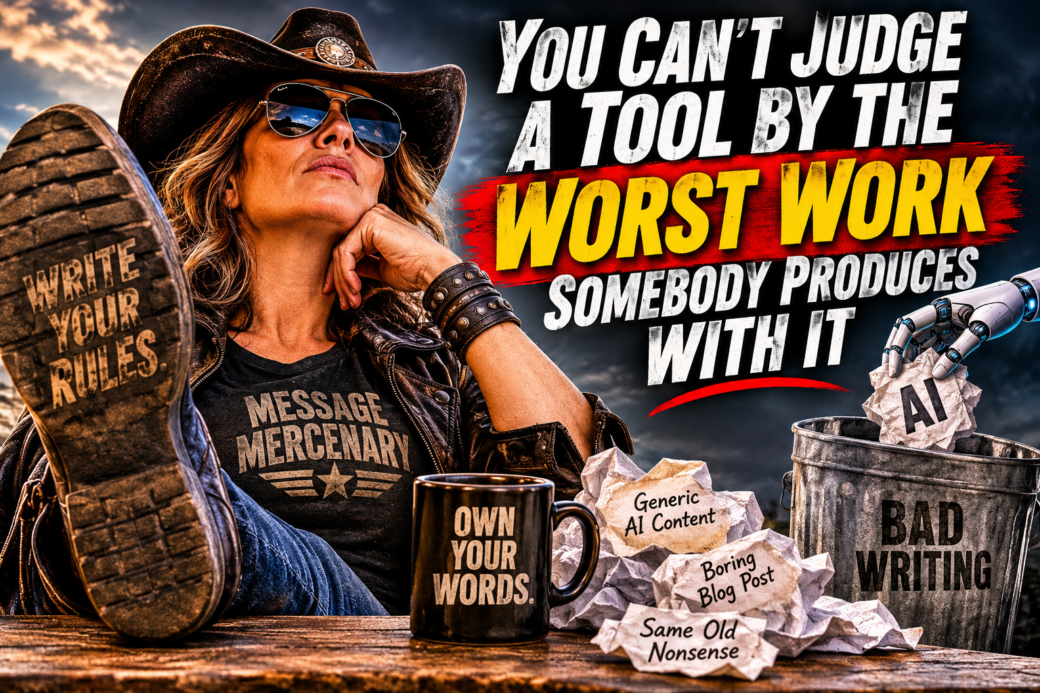
Are we crucifying paintbrushes now?
I'm just asking because I've seen some pretty terrible paintings in my lifetime, and I'm beginning to wonder if we've been letting art supplies get away with murder.
I mean, have you seen what some people do with a paintbrush? Good Lord. Somewhere, Picasso is spinning in his grave, and Bob Ross is quietly reconsidering his commitment to happy little trees.
And let's talk about AutoTune. Kanye West didn't exactly need a technological intervention to make people argue about his music, but somehow we managed to survive the existence of AutoTune without declaring the entire technology a threat to artistic integrity.
Yet here we are.
Artificial intelligence produces a piece of generic, lifeless writing, and suddenly we've got people clutching their literary pearls, screaming about the death of creativity, and demanding that everyone using the technology explain themselves before the Supreme Court of Self-Appointed Writing Purists.
Apparently, we've reached a point where the quality of someone's writing is no longer a reflection of their ability to write. It's a referendum on the tool they used.
Interesting.
Because I've got a question.
Where the hell was all this outrage before AI showed up?
We've had awful writing for centuries. And nobody seemed particularly interested in declaring the tools responsible.
Remember Waterworld? Or Willow? Or practically every 80s breakdancing movie that somehow made it past a production meeting? Did we demand that Hollywood confiscate the cameras? Did we threaten the screenwriters' pencils with a woodchipper?
No.
We criticized the movies.
We made fun of them. We questioned the creative decisions. We wondered how something so spectacularly ridiculous got approved by multiple adults who presumably had functioning brains.
But we didn't blame the camera.
We understood that a tool and the person using it are two entirely different things.
But now, that distinction has become too complicated for some people to grasp.
The Great AI Double Standard
Here's what I find particularly entertaining about the anti-AI writing crusade.
For decades, we've tolerated bloated government documents that require a search-and-rescue team to find the actual point. We've endured corporate memos so lifeless they could qualify as a controlled substance. We've read derivative novels, empty motivational slogans, recycled self-help advice, and enough generic internet content to make a landfill look intellectually stimulating.
And let's not forget the social media posts.
Oh, the social media posts.
Thousands upon thousands of words that say absolutely nothing. Inspirational quotes that have been regurgitated so many times they've lost whatever inspirational value they might have once possessed (Live. Laugh. Love. Vomit.). Articles that use 1,200 words to communicate something that could have been said in a single sentence.
We've been back-stroking in mediocre writing for YEARS.
But nobody organized a public execution of Microsoft Word.
Nobody started a movement to ban keyboards because someone wrote an abhorrent blog post.
Nobody demanded that every author disclose whether they used spellcheck before publishing a book.
Then AI arrives.
Suddenly, the same generic, lifeless content that has been polluting the internet since the dawn of blogging becomes an indictment of the technology itself.
People are outraged that AI can produce boring writing.
It would seem that they haven't been paying attention to the internet.
Here's the difference: AI allows someone to produce 50 versions of the same mediocre nonsense in the time it once took to write five.
That's certainly a productivity improvement.
Unfortunately, productivity and quality are not the same damn thing.
AI can help you produce more. It cannot automatically make what you're producing worth reading.
And that's where the real problem begins.
The Tool Isn't the Problem. The Absence of Judgment Is.
Let's get something straight.
AI can absolutely produce terrible writing.
It can produce generic introductions, predictable conclusions, recycled phrases, empty transitions, and paragraphs that sound like they were assembled by a committee of motivational refrigerator magnets.
It can also help someone mass-produce mediocrity at a breathtaking rate.
But here's the thing.
The problem isn't that AI can produce bad writing. The problem is that people keep confusing the tool with the person using it.
AI doesn't get to make the final cut.
The writer does.
YOU decide what ideas deserve attention. YOU decide what belongs in the piece, what needs to go, what sounds ridiculous, what lacks substance, and what needs to be pushed further.
YOU supply the judgment, the perspective, the experience, the specificity, the original thinking, and the point of view.
Or at least, that's what a writer is supposed to do.
If you open an AI tool, type three sentences of generic instructions, accept the first thing that comes back, and publish it without another thought, we have a problem.
But that problem isn't necessarily AI.
It's the your decision to surrender your responsibility for producing something worth reading.
You can do the exact same thing without AI.
You can sit down with a perfectly good keyboard, type out 1,500 words of recycled nonsense, hit publish, and send another contribution into the already overcrowded cemetery of forgettable internet content.
Nobody stops you.
Nobody calls it a threat to civilization.
Nobody suggests that your keyboard should be confiscated.
But use AI to help develop an original idea, sharpen an argument, explore a different perspective, or turn an observation into a compelling article?
Well, apparently, you've committed a literary felony.
Make it make sense.
Let's Talk About What AI Actually Learned From Us.
Here's another little detail that seems to get lost in the outrage.
AI didn't magically appear on Earth with a suitcase full of human knowledge and a secret agenda to destroy the writing profession.
It learned from the enormous body of information humans have produced.
That includes extraordinary literature, brilliant arguments, thoughtful essays, historical documents, creative storytelling, and some of the most remarkable examples of human communication ever created.
It also includes government paperwork, corporate jargon, ridiculous internet arguments, poorly written articles, empty motivational content, and approximately 47 GAJILION variations of the phrase, "Believe in yourself and never give up."
We fed the machine the good, the bad, and the spectacularly stupid.
And now some people are shocked that it can produce all three?
What exactly did you expect?
If you spend decades feeding a system human language, including all of our brilliance and all of our mediocrity, why would you expect every result to emerge as a literary masterpiece?
AI is not a substitute for discernment.
It needs direction.
It needs someone who knows what they're trying to communicate and has enough critical thinking ability to recognize when the output is missing the mark.
Think of it this way.
AI is a bush hog's steering wheel.
Without someone guiding it, that thing is going to wander off course, carve some bizarre patterns into the landscape, and potentially mow down something that wasn't supposed to be mowed down.
The steering wheel isn't defective because the driver doesn't know where the hell they're going.
It requires a driver.
And if you're the writer, congratulations. That's your job.
Maybe the Outrage Is About Something Else.
Now, I'm going to say something that might make a few people uncomfortable.
Sometimes, the loudest criticism of a new tool has very little to do with the actual capabilities of the tool.
Sometimes, it has everything to do with the person criticizing it.
There is a certain satisfaction in believing that your way of doing something is the only legitimate way to do it.
It gives you a little superiority boost. The warm cuddles that you're doing things the right way while everyone else is taking shortcuts, cheating, or compromising their integrity.
And if someone discovers a tool that helps them work differently, faster, or more effectively, well, that can be rather inconvenient to the little hierarchy you've constructed in your head.
Suddenly, your preferred process isn't the only process.
Your methods aren't the only methods.
And someone who uses a tool you disapprove of might actually produce something better than what you produce.
Heaven forbid.
If your confidence as a writer depends on someone else's decision NOT to use AI, perhaps the problem deserves a little more introspection.
Because criticizing bad writing is perfectly reasonable.
Calling out generic, soulless, derivative content? Absolutely.
Demanding that writers take responsibility for the quality and integrity of their work? I'm right there with you.
But declaring an entire technology worthless because someone used it to produce something terrible?
That's not intellectual superiority.
That's a double standard wearing a fancy literary hat.
Stop Asking the Wrong Question.
The question isn't whether AI can produce bad writing.
Of course it can.
So can humans.
The question isn't whether someone used AI to help create a piece of content.
The question is whether the person behind that content actually contributed something worth reading.
Did they bring an original idea to the table?
Did they have a perspective?
Did they challenge an assumption, tell a meaningful story, make an observation, expose a contradiction, or communicate something in a way that makes another human being stop scrolling?
Did they exercise judgment?
Did they make decisions about the writing instead of blindly accepting whatever appeared on the screen?
That's what matters.
And here's something every writer should understand: your job isn't to prove that you can suffer through the writing process without assistance.
Your job is to communicate something meaningful.
If AI helps you explore an idea, challenge your thinking, identify weaknesses in an argument, or make your own words more compelling, why would you automatically reject that?
Are we really going to start measuring writing integrity by how difficult someone makes the process for themselves?
Should we also ban calculators because some accountants can do math in their heads?
Should we stop using spellcheck because a writer ought to know how to spell every word?
Maybe we should go back to chiseling our articles into stone tablets. At least then we'd know the writer was committed.
There is a difference between using a tool to help you think and using a tool to do your thinking for you.
Learn the difference.
Practice the difference.
And for the love of all things literary, stop confusing the two.
Put Down the Pitchfork. Pick Up Your Standards.
I'm not suggesting that every piece of AI-assisted writing deserves applause.
It doesn't.
Some of it is awful. Some of it is lazy. Some of it is so painfully generic that I'd rather read the ingredients on a bottle of shampoo.
Criticize it.
Reject it.
Tell the writer to go back and do better.
But stop pretending the tool is responsible for every bad decision made by the person holding it.
Because we've had terrible writing long before AI came along. We've had uninspired authors, lazy arguments, empty content, and people who confuse putting words on a page with having something worth saying.
AI didn't invent mediocre writing.
It just gave mediocrity a faster production schedule.
And if you're genuinely concerned about the quality of writing in the world, perhaps your energy would be better spent encouraging original thought, stronger arguments, better storytelling, and writers who actually give a damn about what they're putting into the world.
Don't judge a tool by the worst work somebody produces with it.
Judge the work.
Judge the thinking behind it.
Judge the person who decided that something half-baked was good enough to publish.
But don't blame the paintbrush because somebody painted a hideous picture.
The problem was never the paintbrush. It was what somebody decided to do with it.
-Amber
P.S. And if you're one of those writers who wants to use AI without handing over your brain, your creativity, or your voice in the process, I've got something for you.
Introducing THE AI OUTLAW.
This isn't about asking AI to write your articles while you sit back and collect the credit. It's about learning how to use AI as a creative tool to develop YOUR original ideas, sharpen YOUR arguments, strengthen YOUR writing, and make YOUR voice impossible to ignore.
I'll show you how to take your own observations, experiences, opinions, and ideas and turn them into compelling content without surrendering your identity as a writer.
No cookie-cutter content. No robotic word vomit. No letting a machine become the author of your thoughts.
WRITE YOUR RULES. OWN YOUR WORDS.
If you're ready to stop apologizing for using a tool and start learning how to use it like a writer who knows what the hell they're doing, come join me.