
There’s a strange moment that happens when you stop lowering your standards for other people.
At first, you think it will inspire them.
That’s the adorable part.
You think: “If I work harder, stay disciplined, tell the truth, follow through, and actually care about quality, maybe it’ll elevate the people around me.”
Instead, what usually happens is everyone starts looking at you like you’re the weird one for still trying.
Not evil. Not dangerous. Just… inconvenient.
Like the guy who still uses turn signals in Florida traffic as if civilization hasn’t already collapsed.
That’s the real loneliness of standards.
Not that people fail them.
People have always failed standards.
It’s when the culture itself starts treating standards as offensive.
I remember talking to someone once who said they stopped trying so hard at work because they realized the people getting promoted weren’t the most competent — they were the most politically adaptable.
Translation: The people succeeding weren’t the people carrying the weight. They were the people best at avoiding blame when the weight crushed somebody else.
And honestly? Most adults eventually discover this horrifying little secret.
A shocking percentage of modern systems are held together by about three exhausted people and one woman named Denise who has passwords written in a notebook from 2007.
The rest is meetings.
That realization changes people.
Some adapt. Some surrender. Some become cynical. And some quietly decide: “No. I’m still going to do things correctly even if nobody notices.”
Those people pay a price.
The world loves standards in theory.
In practice, standards are deeply annoying.
Everyone says they want accountability until accountability arrives carrying a clipboard.
Everyone says they want excellence until excellence requires effort.
Everyone says they value honesty until honesty becomes expensive.
That’s why the clean room in a dirty house becomes offensive.
Not because cleanliness is wrong. Because it silently exposes neglect.
A person with standards unintentionally becomes a mirror.
And mirrors make people uncomfortable.
You see this everywhere now.
The employee who still answers emails thoroughly becomes “intense.”
The friend who keeps promises becomes “too serious.”
The person who shows up on time becomes “rigid.”
The creator who refuses low-effort garbage gets told: “You’re overthinking it.”
No. They’re thinking about it exactly enough.
We’ve just normalized carelessness to the point where effort looks emotionally aggressive.
That’s the bizarre cultural shift nobody talks about.
Mediocrity used to embarrass people.
Now people protect it like it’s an identity.
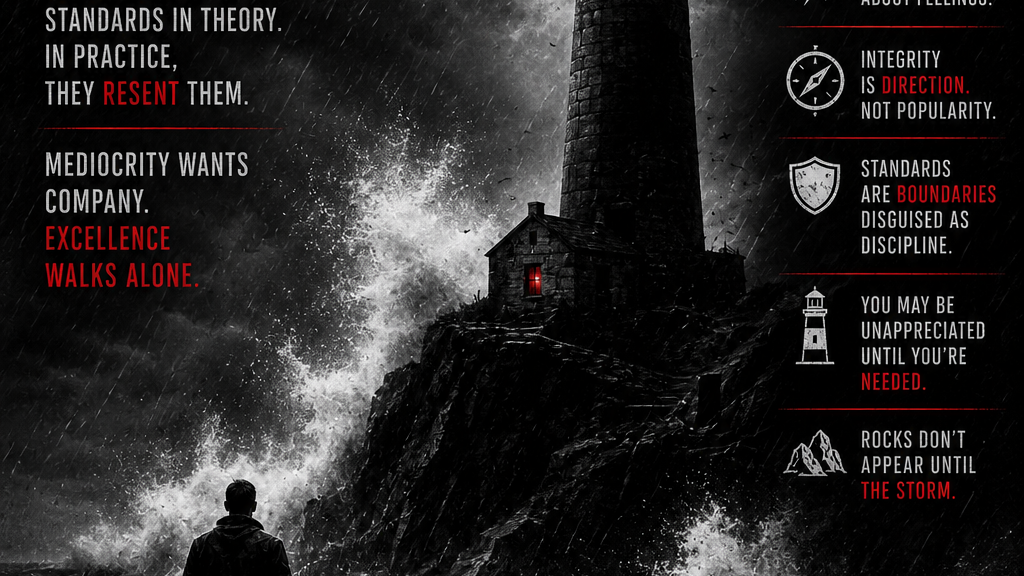
There’s a reason the lighthouse metaphor resonates so deeply.
A lighthouse stands alone by design.
It doesn’t negotiate with storms. It doesn’t drift with currents. It doesn’t dim itself because ships feel judged.
It simply stands there: consistent, predictable, unmoving.
Which sounds noble until you realize how lonely that actually is.
Because lighthouses are usually appreciated during disasters.
Not before them.
Before the storm, everyone thinks the lighthouse is dramatic.
Then the rocks appear.
Suddenly everybody wants standards again.
Funny how that works.
One of the best examples of this tension is .
The sheriff spends the movie asking for help from the town.
Nobody wants involvement once courage becomes inconvenient.
Everyone supports principles right up until principles become costly.
That’s not just an Old West story. That’s basically every workplace in America.
The moment integrity threatens comfort, people suddenly discover they’re “staying out of it.”
And to be fair, sometimes that’s survival.
But eventually a culture reaches a dangerous point: the people willing to stand alone become rarer than the people willing to compromise.
That’s when systems start rotting from the inside.
The truly exhausting part about standards is that they rarely produce applause.
Usually they produce maintenance.
Nothing breaks. Nothing collapses. Nothing catches fire. No crisis happens.
Which means nobody notices the effort.
Preventing disaster is thankless because successful prevention looks identical to “nothing happened.”
It’s carrying water uphill every day so other people can complain the mountain looks dry.
That’s why disciplined people burn out.
Not because discipline is impossible.
Because invisibility is exhausting.
And eventually the temptation arrives.
The big one.
The question underneath the entire article:
What if you just stopped caring so much?
What if you relaxed your standards? Cut corners? Played politics? Ignored problems? Stopped expecting integrity? Stopped believing people should mean what they say?
You’d probably fit in faster.
That’s the brutal truth nobody wants to admit.
Lowering standards is socially efficient.
It makes group acceptance easier because groups are often built around mutual tolerance for mediocrity.
Nobody likes the person still trying when everyone else quietly agreed to stop trying years ago.
That person disrupts the peace treaty.
That’s why still resonates with people even decades later.
Howard Roark would rather destroy his own work than dilute it into something dishonest.
Now, obviously, taken too far, that mindset becomes insufferable. Nobody wants to have dinner with a human TED Talk about granite and purity.
But the emotional core hits hard: At what point does compromise become self-betrayal?
That question haunts people with standards.
Because they know the danger isn’t sudden collapse.
It’s gradual negotiation.
A little less honesty here. A little less effort there. A few more excuses. A few more tolerated behaviors.
Until eventually you wake up one day realizing you became the exact type of person you used to quietly resent.
That’s the real fear.
Not loneliness.
Drift.
There’s a scene in where Batman takes the blame to preserve something larger than himself.
That’s the hidden burden of standards.
The person holding the line is often misunderstood while doing it.
People assume standards are ego. Or judgment. Or self-righteousness.
Sometimes standards are simply grief.
Grief over how low the bar has fallen.
Grief over watching craftsmanship disappear. Character disappear. Reliability disappear.
Grief over realizing that basic competence now looks exceptional.
We live in a time where answering your phone, showing up prepared, and keeping your word makes people describe you like you’re a medieval knight returning from war.
“Wow. Rare guy.”
No. That used to be normal.
And still, despite all this, people with standards keep going.
Why?
Because eventually they realize something important:
Standards are selective.
Not everyone is supposed to stay in your life.
Not every environment deserves access to you.
Not every room deserves your effort.
That sounds arrogant until you reverse it.
Would you hand priceless equipment to careless people? Would you trust fragile things to irresponsible hands? Would you build a lighthouse in a swamp and expect appreciation from people selling boats made of cardboard?
Probably not.
Standards are boundaries disguised as discipline.
They protect identity.
The irony is that society rediscovers the value of standards every single time things go wrong.
When the plane shakes violently, suddenly everyone wants the pilot obsessed with procedure.
When the economy crashes, everyone wants competent leadership.
When corruption spreads, everyone wants integrity.
When systems fail, nobody says: “Quick, find me someone relaxed about details.”
No. In moments of crisis, humanity desperately searches for the people it mocked during comfort.
The people who still cared.
The people who maintained discipline.
The people who refused drift.
The lighthouse.
And maybe that’s the hardest lesson of all.
The loneliness of standards never fully disappears.
You will lose rooms by refusing to shrink. You will lose approval by refusing dishonesty. You will lose relationships built entirely on tolerated disappointment.
But there’s another kind of loneliness people rarely talk about:
The loneliness of becoming someone you no longer respect.
That loneliness is heavier.
Because at least when you keep your standards, you can still recognize yourself in the mirror.
Even if you’re standing there alone.
Like a lighthouse in a storm everyone swore was never coming.