
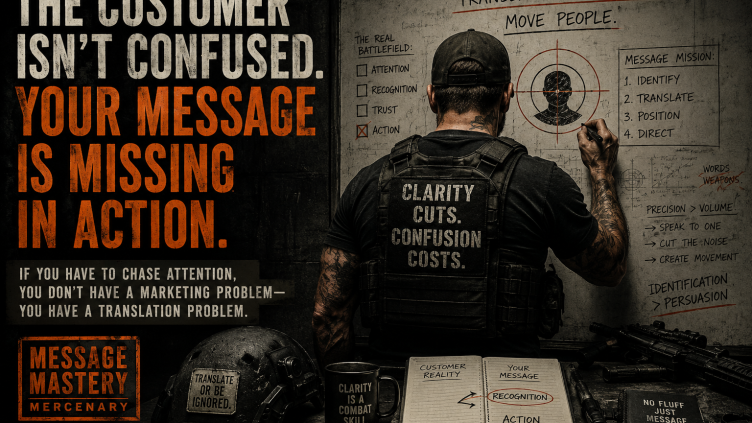
If you have to chase attention, you don’t have a marketing problem—you have a translation problem.
Let’s get something out of the way immediately.
Your audience is not “hard to reach.”
They’re not hiding.
They’re not waiting for the right time.
They’re drowning in messages that all sound like they were written by the same committee of well-meaning ghosts.
And somewhere in that noise, you’re wondering why your offer isn’t landing.
Here’s the uncomfortable truth with boots on:
You don’t have a traffic problem. You don’t have an algorithm problem. You have a clarity under fire problem.
Meaning: if your words don’t cut through instinctively, nothing else you do matters.
Not ads. Not funnels. Not branding color palettes that look like “trust me bro” blue.
Because before people ever buy your thing, they have to recognize themselves in your language.
And right now? They don’t.
THE MARKETPLACE ISN’T BROKEN. IT’S OVERFED.
People aren’t sitting around waiting for more content.
They are actively filtering it out.
Every scroll is survival mode. Every headline is either ignored or instantly sentenced.
So when your message shows up soft, vague, or “professional,” it doesn’t get considered.
It gets erased.
Which brings us to the real battlefield skill nobody wants to practice:
Copywriting.
Not “writing pretty posts.”
Not “being consistent.”
Not “sharing your story.”
Copywriting is the ability to take what’s already inside your customer’s head… and throw it back at them in sharper language than they’ve ever used for themselves.
That’s it.
That’s the job.
Everything else is decoration.
STEP 1: IDENTIFY WHO YOU’RE ACTUALLY SPEAKING TO
Not demographics.
Not avatars.
Not “female entrepreneurs aged 30–45 who like coffee and chaos.”
That’s brochure language.
Real targeting looks like this:
What do they do when nobody is watching?
What are they tolerating that they refuse to admit out loud?
What are they secretly Googling at 1:13 a.m. and deleting from their search history?
Because people don’t buy solutions.
They buy relief from private pressure.
If you can’t describe their inner world with uncomfortable accuracy, you’re not ready to write to them.
You’re guessing.
And guessing is expensive.
STEP 2: NAME THE THING THEY’RE AVOIDING
Every market has a hidden wound.
Not a “challenge.” Not a “pain point.” Not a polite inconvenience.
A pressure point.
The thing they’re building entire routines around avoiding.
Your job is not to gently acknowledge it.
Your job is to describe it so clearly they feel caught.
Because recognition creates attention.
And attention is the first transaction.
But here’s the discipline most people skip:
You don’t get to exaggerate it.
You don’t get to dramatize it into fiction.
You translate reality.
You say:
“This is what it feels like when you’re doing everything right and still falling behind.”
“This is what it looks like when you’re exhausted but still expected to perform.”
“This is what it sounds like in your head when you’re smiling on the outside and negotiating with panic on the inside.”
When you get that right, people don’t think, “interesting copy.”
They think, “how did they know that?”
STEP 3: POSITION YOUR SOLUTION AS STRUCTURE, NOT SAVIOR
Here’s where most messaging collapses into fantasy.
They overpromise transformation like they’re selling lightning strikes.
Don’t do that.
Your audience doesn’t need magic.
They need direction that reduces friction.
So instead of:
“This will change your life!”
Say:
“This is how you move from stuck thinking into repeatable action without second-guessing every step.”
Specificity builds trust.
Vagueness builds skepticism.
And skepticism is where sales go to die quietly.
Your product isn’t the hero.
Your clarity is.
Your structure is.
Your ability to make complexity feel navigable is.
STEP 4: TELL THEM EXACTLY WHAT TO DO NEXT
Do not assume motivation will carry the final step.
It won’t.
Even interested people hesitate at the finish line if you make them think too much.
So you remove thinking.
You replace it with direction.
Not:
“Click the link below.”
But:
“Here’s the next move. Do this. Then this happens. Then you’re in.”
And importantly—you remove ambiguity about outcome.
People don’t just want access.
They want to know they won’t be stranded after they say yes.
So you guide them through the doorway before they even step in.
That is what converts attention into action.
FINAL TRANSMISSION
If your message isn’t working, stop assuming people don’t care.
They care deeply.
They’re just selective about what gets through the noise.
And right now, most marketing sounds like noise dressed up as strategy.
The advantage is not bigger budgets.
It’s not better tools.
It’s sharper translation.
Because when your message accurately reflects your customer’s internal reality, something shifts instantly:
They stop scrolling.
They stop doubting.
They start recognizing themselves in your words.
And that moment?
That’s not persuasion.
That’s identification.
Everything after that is just logistics.
Before you go…
If you’ve ever caught yourself muttering, “Why does nobody SAY this stuff?” while mentally outlining an article in the shower... congratulations. You’re one of us.
If you want to turn those everyday observations, weird epiphanies, and delightfully unpopular opinions into essays people actually finish reading, I can’t recommend Ash Ambirge’s Crowbar Writing Workshop enough. It’s not for novelists chasing the next great work of fiction. It’s for coaches, consultants, business owners, marketers, and professionally opinionated humans who are tired of sounding like they swallowed a LinkedIn buzzword generator. It teaches you how to find the story hiding inside ordinary moments—and write in a way that makes people stop scrolling, laugh unexpectedly, argue in the comments, or quietly rethink something they believed five minutes ago.
If that sounds like your kind of trouble, you can check it out using my affiliate link below. If you decide to join through my link, I’ll earn a commission—and a portion of that goes directly to Craft Cottage Animal Foster Sanctuary, the little foster sanctuary I run on my property for animals in my county and the surrounding areas. So your investment might help you rescue your writing voice... and accidentally help rescue a few four-legged freeloaders, too. I’d call that a pretty good day’s work.